What I Learned From Hosting a Dream Retreat
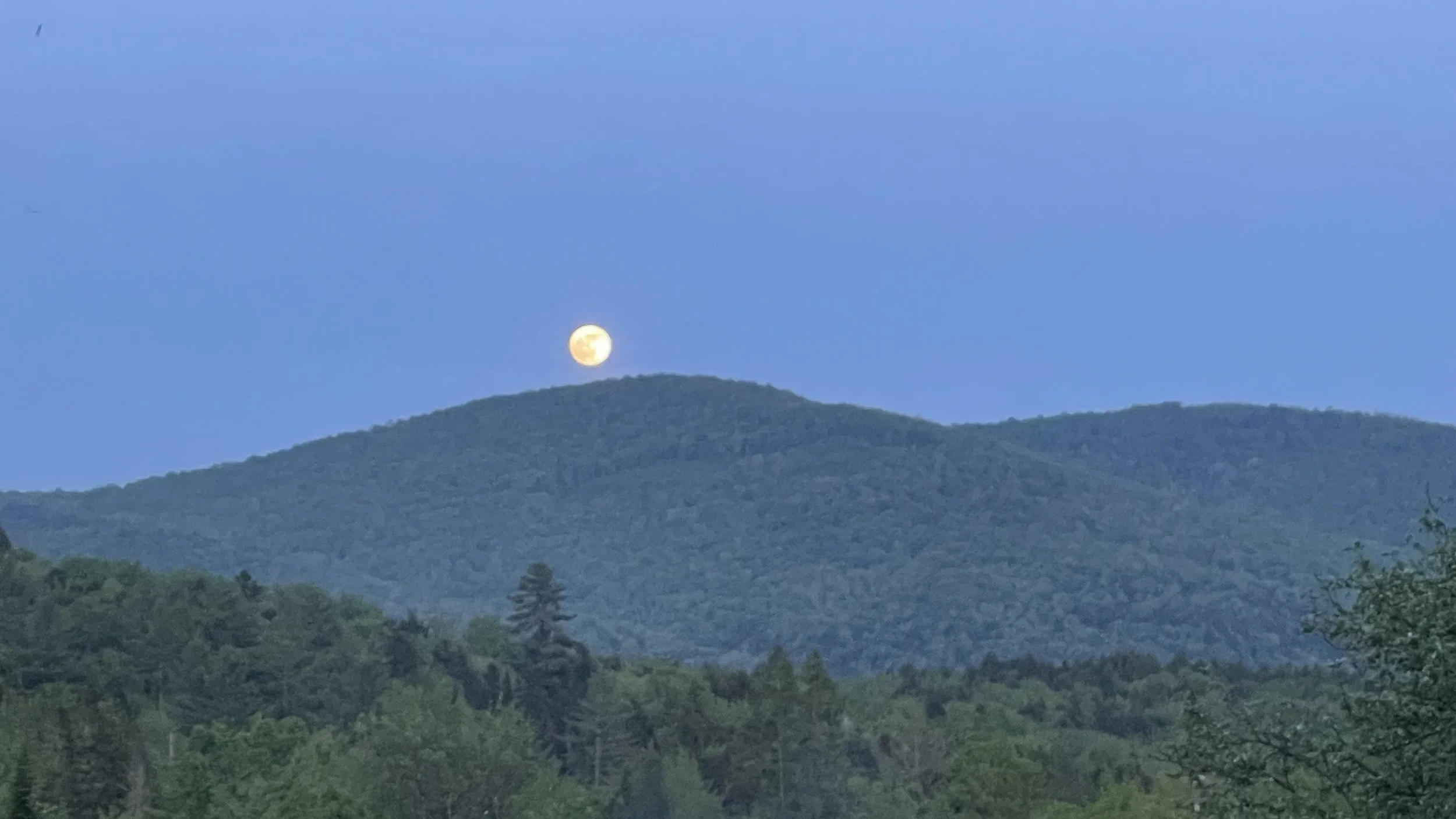
A few weeks ago, seventeen of us gathered in the mountains of Vermont to spend a weekend dreaming together.
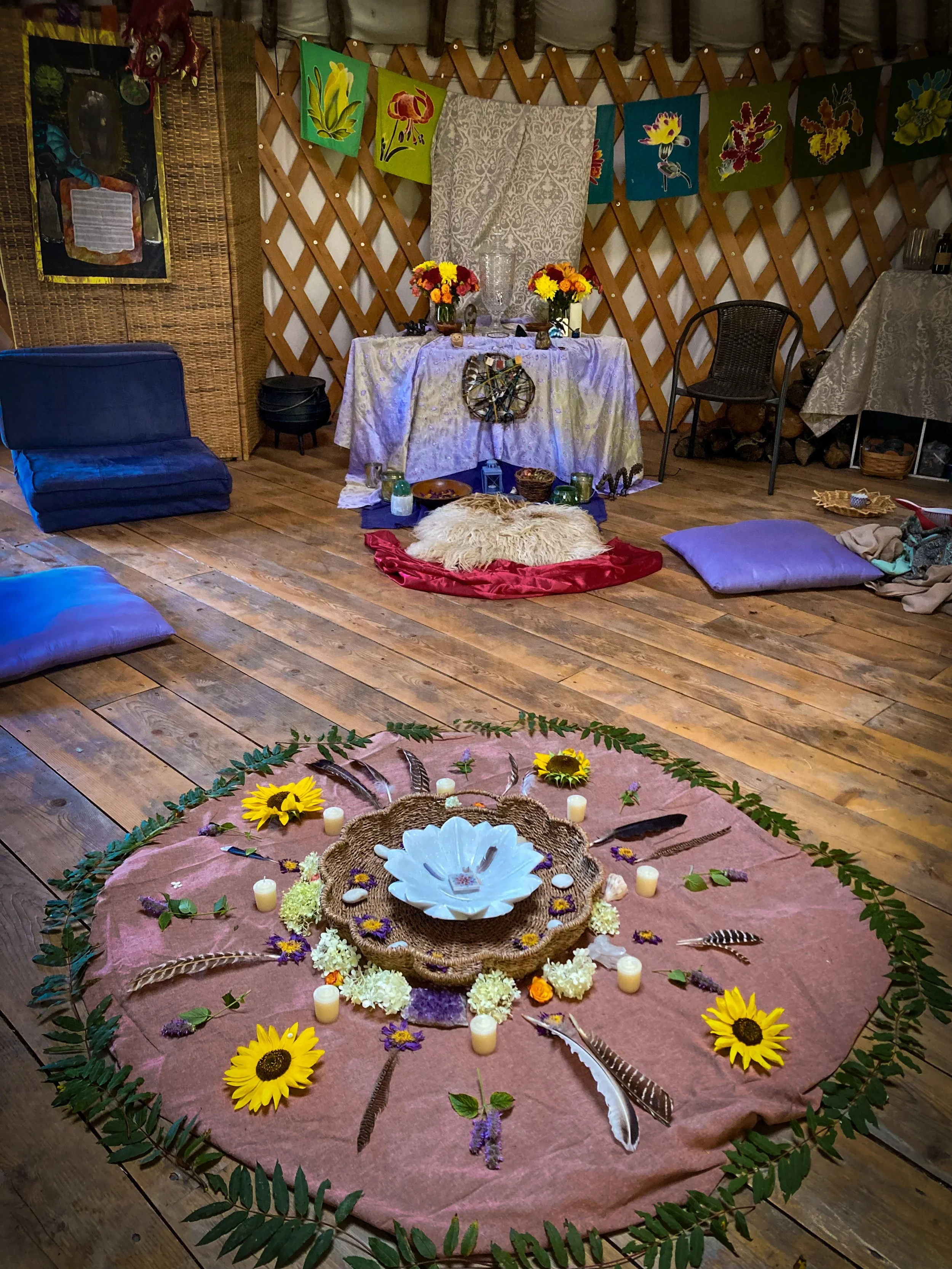
We drank dream elixirs with special dream-enhancing plants. We charmed our dream journals and set strong intentions to receive and recall guiding dreams. Some of us slept directly on the earth, in the stone circle. We purified ourselves with bundles of mugwort dipped in faerie well water. We walked a labyrinth by moonlight. We made masks and embodied beings from our dreams. We encountered bears, porcupines, snakes and other wild animal beings. We danced around a fire and sang chants that I heard first in dreams. We shared dreams in council each morning. We experimented with some of the ancient human practices of treating dreams as sources of guidance, healing, creativity, and mystery.
I spent years envisioning and planning this retreat. Watching something I had dreamed about for so long come to life before my eyes was deeply fulfilling, in a way that’s hard to put into words.
I came away with a notebook full of new dreams, but also with some lessons about what happens when we make enough space for dreaming to become a communal practice again.
1. Plan carefully, but leave lots of room for the mystery.
I am a planner.
I make lists. I anticipate possible problems and create Plans B and C. Some of this is temperament, and some comes from having learned to be highly self-reliant and responsible. As a facilitator, it's also useful. Good preparation allows people to feel held.
But years of hypnotherapy and dreamwork have taught me something that runs directly against this tendency:
Leave room for the mystery. There is so much potential in our unconscious minds than there is in the conscious mind. Let go of the need to control every moment, and let the dreamworld lead.
When I first envisioned this retreat, I began incubating dreams about it. I asked what wanted to happen, what belonged in the ceremonies, what I needed to know.
I got many answers, but none of the dreams came through with practical info like schedules.
Instead, my dreams showed me images, and feelings. They gave me experiences.
I dreamed of dancing and spinning, faces flashing before me as we turned and made intimate eye contact. I dreamed of masks. And in one particularly vivid dream, my friend Elizabeth and I were performing an ancient-feeling ritual in a cave that reminded me of one I had visited in Crete.
We were singing call-and-response. Elizabeth led and I answered, although I had the strange certainty that we had exchanged these roles before. As we sang, women began arriving. Soon the cave was full of them. At the back was a clear spring, and one by one, some of the women slipped into the water and began swimming like mermaids.
I woke with the melody still hanging in the air.
So I went to the piano and found the notes before they disappeared.
Eventually, that fragment became a three-part chant that I taught at the retreat.
I asked Elizabeth to be a priestess in the dream temple with me, and she agreed.
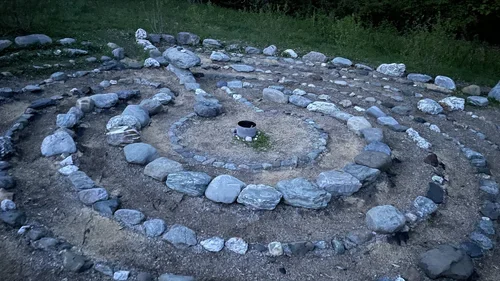
On our first night, after our Blue Water Lily ceremony, Elizabeth and I stood hidden behind the hazel hedge surrounding the labyrinth. One by one, dream seekers walked the winding path in darkness, carrying tiny lights. From behind the hedge, they heard our disembodied voices singing the round. Later, several told me that something about the experience had blurred the boundary between waking and dreaming.
Then the following day, I sent everyone out alone to find a plant, tree, body of water, or other element of the landscape that seemed to call them and spend time dreaming with it.
Without coordinating or speaking with one another, people began arriving at the pond.
Just like the mermaids from my dream, one by one, they slipped silently into the water.
Did I dream it because it was going to happen? Or did it happen partly because I had dreamed it and subsequently created conditions that allowed it to happen?
I don't know.
Dreamwork has made me increasingly comfortable saying those three words: I don't know.
But I do know that leaving gaps in the schedule, something that made the planner in me extremely nervous, allowed some of the most memorable experiences of the weekend to emerge.
Preparation built the vessel, and the empty spaces allowed something else to fill it.
2. Group energy amplifies the power of dream incubation.
Dream incubation is an ancient practice with a very simple premise: go to sleep with an intention to receive a dream.
Ancient versions of this practice could be considerably more elaborate. In the healing sanctuaries of Asklepios in the Greek world, pilgrims prepared themselves before entering sacred sleep in hopes of encountering the healing god or receiving guidance.
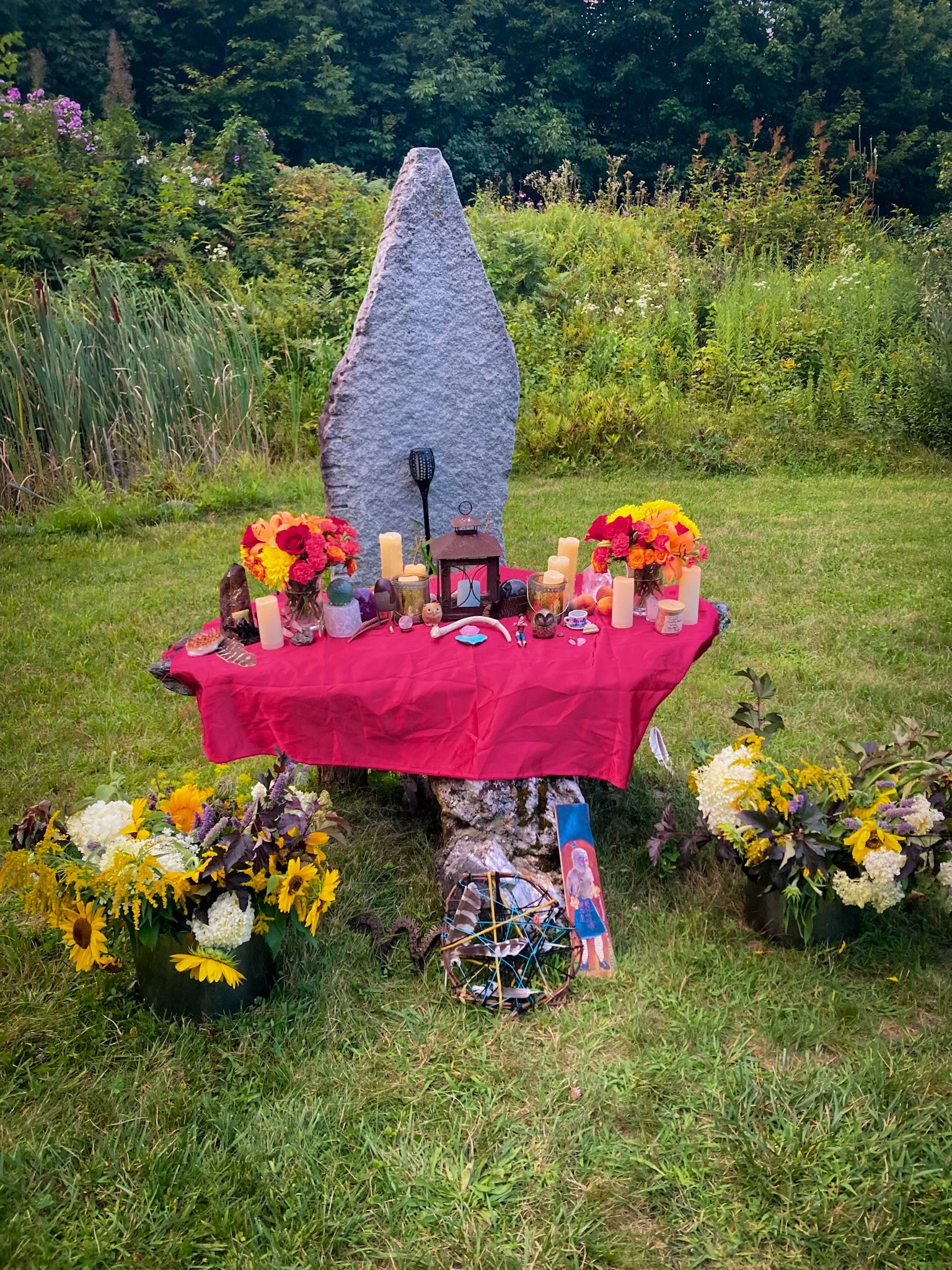
At our Vermont dream temple, we borrowed the underlying architecture: prepare, cross a threshold, formulate an intention, enter sacred sleep, receive, remember. But we wove in other traditions and elements: the plant magic of oneirogens from different cultures; the stones, plants, trees, waters, and other seen and unseen beings of the land that hosted us; and some of the Druid rites that have been practiced there for more than twenty years as home to the Green Mountain Druid Order.
Instead of creating a hierarchy of dream attendants and dreamers, gods and supplicants, each participant was invited to step into both roles: dream temple attendant and creator, as well as participant and pilgrim.
We let the dreams lead, with facilitators serving as guides, servants, and container-holders rather than experts.
What struck me most was the power of witnessing other people's dream breakthroughs, visions, and insights.
In dreams, thought and expectation can have remarkable creative power. If you become lucid in a dream, you can sometimes literally watch a thought appear as a character, or see the dream landscape transform in response to your attention and intention. In my own lucid dreaming practice, I've been amazed by the way a strong, clear intention can result in a dream response that is even better, stranger, or more beautiful than I could have imagined.
But watching something similar occur within a group of synchronized dreamers was really powerful.
No, dreams are not vending machines that spit out our desires on command. But with focus and intention, amplified by a group of dreamers gathered on sacred land, in relationship with plants, place, and the beings with whom we shared it, it's amazing what a little dream incubation can do.
People who told me they rarely remembered dreams began remembering them. Dreams appeared before the retreat had even begun, while participants were preparing their intentions. Someone who had been struggling with frightening dreams received a dream that shifted their relationship to dreaming. And the synchronicities continued after people returned home.
Lynne McTaggart, author of The Intention Experiment and The Field, has spent years exploring the provocative idea that focused group intention may have effects beyond the individual. Whatever we ultimately make of that research, something about our experience made me wonder about intention in a new way.
Once seventeen people begin paying attention together, the field changes.
3. Dreams want bodies.
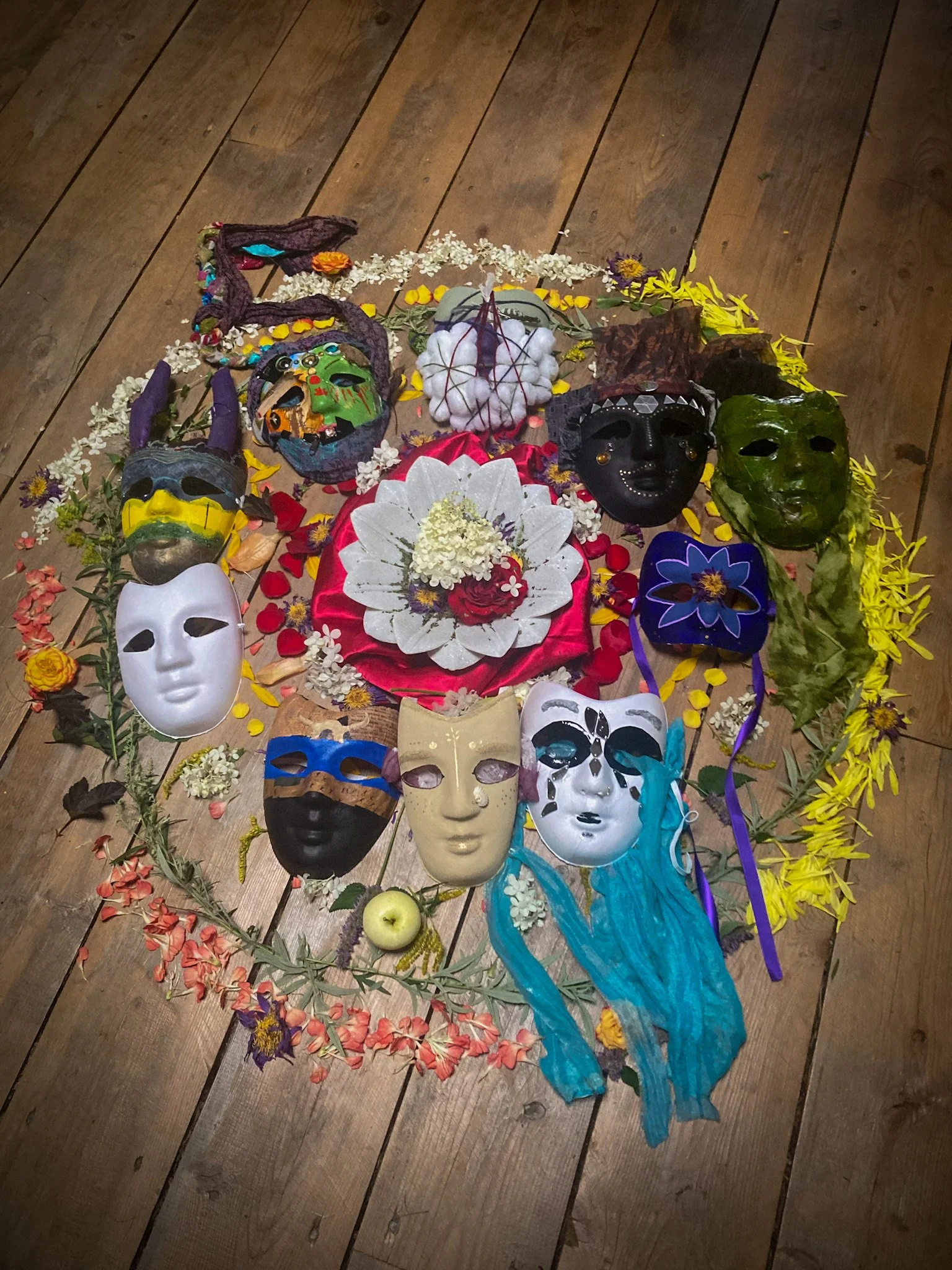
One of the central ceremonies of the weekend involved making masks and embodying beings from our dreams.
Around the fire that night, the ordinary identities of the people I had spent the day with seemed to disappear behind feathers, antlers, paint, cloth, strange faces and animal forms.
People later told me that simply looking around that circle was one of the images they knew they would carry home.
This idea isn’t new. It’s inspired by the ancient Greek prosōpon, the face or theatrical mask, and ancient Asklepian dream incubation belong to different ritual contexts. But bringing them together allowed us to explore an old idea in a new way:
What happens when the invisible is given a body?
Dreamwork can become terribly cerebral. We wake up and immediately ask, What does it mean? We can get stuck analyzing and fixing meaning to symbols in a way that kills what is alive in the dream.
But Jung's active imagination, Fritz Perls's Gestalt dreamwork, psychodrama, Robert Bosnak's Embodied Imagination, and contemporary dream teachers have all explored variations of a different kind of approach to dreamwork in which we can step into the dream symbols.
In embodied dreamwork, rather than interpreting the wolf that appears in the dream, we become the wolf, and see what it feels like to move around as the dream wolf. Feel what happens to your shoulders, jaw, breath, and attention when you inhabit its perspective.
One of the most interesting moments of the dream share circle on Saturday was when the facilitator invited us all to play a part in bringing the dream to life. The dreamer became the director, choosing people to play different roles, and each of us moving around and performing the dream in real time.
I experienced this kind of dreamwork in a powerful way at Katherine Bell’s morning dream circle at the IASD conference this summer. I got the chance to be in the director part, to have other people act out my dream, and it completely changed the way I understood and related to that dream.
Sometimes the body understands a dream much more than the analytical mind does.
4. The animals apparently wanted to participate too.
This was one of the stranger delights of the weekend.
Animals have long inhabited the mythic landscape of dreams, divination, and healing. Serpents were sacred to Asklepios. Delphi carried both serpent and bee imagery. Birds have been read as omens across cultures. Animals populate dreams everywhere.
I had built some of this symbolism deliberately into our retreat, through meditation and through mask making, but what I hadn't planned was for the actual animals to keep arriving.
While I was teaching an earth-serpent dance that had developed through a series of my own dreams and waking synchronicities, a baby snake slithered directly through our circle and between our feet. No lie!
During a conversation about prophetic dreams, an enormous toad hopped beneath a participant's chair, surprising us all, and remained with us for the duration of the discussion.
During our nighttime ceremony, a wonderfully rotund porcupine appeared and settled into the branches of the apple tree by which we were imbibing our herbal dream elixir.
A bear and her cub visited the apple tree around which we'd made ritual and spoken intentions, frightening those of us brave enough to camp nearby.
Barred owls called in the middle of the night just in time to help me recall a meaningful dream image that would have disappeared without their wake up call.
And an unidentified barking dog became inspiration for several visitation dreams in which beloved dogs were reunited with their humans.
What do all of these animal appearances mean?
I don't know that they have to mean any one thing. Each encounter resonated differently for each of us, much as the same dream image can carry an entirely different meaning for different dreamers. What mattered to me was that we noticed and witnessed the moment together. The animals entered the story of the weekend, and suddenly we became aware that the boundary between the dreamworld and the living landscape around us was permeable. How each encounter was encoded into meaning within our personal mythologies is part of the mystery and magic of collective dreaming.
On a basic level, these encounters reminded us all of the power of nature, and the way the other living beings (animal, plant, mineral) also dream and respond to our dreams, and how dreams are conduits for meaningful relationships between each of us and wild nature.
5. Play may be one of the most sophisticated dream practices.
When I first began seriously seeking out dream teachers, I approached dreaming the way I approach many things: I wanted to get better at it. I was raised in a high achieving family, in a culture that rewards accomplishment. I tend to recreate this paradigm in my personal life, often unintentionally. In dreamwork, I carried the toxic striving mentality in the quest for more dreams. Better recall. More lucid dreams. More discipline. More awareness.
My mentor, Dr. Clare Johnson, recognized this almost immediately. Her prescriptions were infuriatingly gentle. Do twenty minutes of yoga nidra. Get a hammock. Write for two minutes without editing it, polishing it, or publishing it.
In other words: stop trying so hard.
Around the same time, I incubated a dream asking how to improve my lucid dreaming.
Instead of receiving an advanced esoteric technique, I dreamed that I was speeding away from school on a motorcycle like a rebel without a cause.
Hard to ignore that message. But I can be a slow learner.
For someone like me, play, pleasure, laughter, freedom, silliness, sensuality and improvisation aren't distractions from the work, they are the work.
Knowing this about myself, and wanting to continue to heal it and to support others to do the same, I deliberately built play into the retreat.
We danced. We wore masks. We became dream creatures. We made strange sounds. We spun around. We laughed. We played Duck, Duck, Nightmare.
Through play, people became more permeable. Our bodies synched up, without needing to explain our histories and personal life details.
Like children on a playground, we suspended the rules and roles of ordinary, consensual reality, like a waking dream in which we pretended we were dream priests and priestesses of ancient days.
What I learned from this is that play is a state close to dreaming. Play is one of the most underrated forms of dreamwork out there.
6. You don’t have to be a guru to gather a circle
Sometimes I can’t help but wonder: Who am I to do this?
Who am I to teach something as vast and unknowable as dreaming? Who am I to work with plants whose traditional knowledge comes from cultures and lineages that aren't mine? Who am I to bring pieces of ancient Greek, Egyptian, Indigenous, European folk, Jungian, hypnotic, herbal, and contemporary dream practices together?
Those questions are often in the back of my mind as I dream big dreams.
The cautionary voice serves an important purpose. It reminds me to research carefully, to credit my teachers and name Indigenous sources. The inner questioner pushes me to distinguish historical evidence from beautiful modern mythology, and to admit when scholarship doesn't support a story I might want to be true.
But after those important questions have been asked, the inner gatekeeper can let me pass. I can step into visibility as a steward of dream practices both old and new.
When I was writing Herbal Dream Magic, I often defaulted to a kind of student voice. I found myself starting sentences with phrases like, “I’m no expert, but…” My mentor and writing coach, Dr. Clare Johnson, pointed this out to me. She challenged my self-image, daring me to claim more authority in my voice as a leader in the field.
The old programming tells me that to be a leader, one must have the right degree, the right pedigree, the right credentials, and the stamp of an institution.
But one thing I love about dreamwork is that each person is the authority on their own dreams. Each dreamer holds power. In dream circles and herbal dream magic, we share that power with each other and with the land, co-creating the sacred and interweaving our personal mythologies into a new collective dream culture.
Writing Herbal Dream Magic helped me reframe my understanding of authority. Instead of waiting for a stamp of legitimacy from some higher institution, I began to see that authority can also grow out of sustained practice. I was doing the research. I was practicing my own herbal dream magic. I was creating, experimenting, learning, and sharing what I learned.
I had to learn to validate my own experience and wisdom because, in truth, I have spent years learning how to listen and relate to dreams, and how to work with plants for dreaming. And I know how to create conditions in which other people can listen, too.
One thing to consider as we create a collective dream culture is that authority doesn't have to mean guru, master, or unquestioned expert. Yes, experience, skill, and depth of knowledge matter enormously. But none of those things creates culture unless we gather and share what we know.
Stepping into the role of dream circle gatherer and dream temple creator taught me that skillful facilitation itself lends a kind of authority- the authority of responsibility.
Communities need people willing to gather everyone together and make the thing happen.
Someone has to invite, organize, schedule, promote, remind, prepare, and follow through.
Someone has to make the tea. Someone has to remember the history and encourage the creativity. Someone has to haul the water, tend the fire, worry about whether there will be enough food, and then stand in front of eighteen people and say: Let's dream together.
And let's face it: in a time when so many of us are overwhelmed and stretched thin, the willingness and capacity to show up, take responsibility, and follow through are precious.
We don't need to pretend we possess all the secrets of the ages or understand the divine mysteries in order to create places where people can encounter mystery.
If we want to shift culture, that’s a kind of authority and responsibility that more of us need to become more comfortable claiming.
7. Food is Important.
Of all the positive feedback I received after the retreat, one of the most common comments was, “The food was delicious!” This made me smile because feeding people well had become surprisingly important to me. Even when the logistics became complicated and I considered simplifying the meal plan considerably, something in me kept insisting: I want people to feel fed.
Fasting has long been part of religious, initiatory, and visionary practices across many cultures. It makes sense. Deprivation is often a catalyst for visionary experiences and changes in perceptions and consciousness. Hunger, sleeplessness, darkness, solitude, and other departures from ordinary life can move us into liminal states where perception changes.
But over years of working with dreams, I've come to believe something else is also true: The dreaming body needs to be nourished.
Rather than depriving ourselves of food, we chose a different kind of fast.
For the weekend, we stepped away from the digital world. We went offline, without electric light or the constant distractions and demands of ordinary life. We slept outside, in tents and rustic shelters, with darkness, weather, animal sounds, and the discomforts that inevitably come with camping.
Sleep itself became a little less ordinary.
And there is something interesting about that. When sleep is disrupted or unfamiliar, we may spend more time hovering around the edges of sleep, where hypnagogic imagery can become vivid and strange. Those liminal states can sometimes become doorways into lucid dreams and other unusual sleep experiences.
But because we were already asking so much of our nervous systems and bodies, I wanted the food to do the opposite.
I wanted people to feel fed.
So I took great care with the meals: warm, wholesome food; locally raised meat, vegetables, and cheese from the farm where I live; hearty breads from Vermont bakeries; abundant breakfasts and lunches; and options that allowed people with different dietary needs to eat well.
The dream elixirs received the same attention. I prepared them deliberately and ritualistically, working with plants traditionally or contemporarily associated with dreaming, while bringing intention and reverence to the brewing itself.
There was something wonderfully grounding about moving between these worlds.
We could drink a mysterious blue flower beneath the stars, walk silently into a dark labyrinth, encounter strange beings around the fire… and then come back and eat.
Dream magic doesn’t require us to abandon the body. In fact, I'm beginning to wonder whether nourishment itself is an altered-state practice. What happens when, instead of pushing the body past its needs in pursuit of transcendence, we make it feel exceptionally safe, warm, rested, and fed?
What If We Grew a New Culture of Dreaming Together?
One of the strongest feelings that has lingered with me since the end of the retreat is the feeling that I don't want this to be a one-time event.
I plan to attend the IASD conference again next year, in Atlanta. I love dream conferences. I love learning about the research, hearing new ideas, encountering beautiful teachers, and sitting in rooms full of people who take dreams seriously.
But another part of me wants something more.
My dream body wants to go into the wild.
It wants to get away from screens and PowerPoints and sit around the fire. It wants bare feet on the earth. It wants to drink strange plants beneath the stars and fall asleep with questions. It wants to dance and chant and make masks and tell stories. It wants to wake in the night to the owls and gather in the morning to tell one another what happened while we were gone.
It wants dreaming to become communal and earth centered again.
The ancient Asklepian sanctuaries offer an intriguing model. They weren't just places where people went to learn about dreams or network with other dreamers. They were healing sanctuaries, places of pilgrimage and restoration, with sacred architecture, water, bathing, theatre, ritual, communal life, and the expectation that healing might come through an encounter with the sacred. They were places people went to encounter the divine.
After hosting my first sacred dream retreat, I am even more deeply interested in the question: can we build places in our current world where dreaming is treated as part of healing, community, creativity, and our relationship with the sacred?
What if we created contemporary dream sanctuaries rooted in the places where we actually live?
I can imagine this retreat becoming an annual gathering, drawing dreamers from across the Northeast, the country, and perhaps eventually the world to these hills and wild spaces.
And I find myself dreaming even bigger.
What if the Northeast became an incubator for a renewed collective dream culture?
What if, alongside conferences and research institutes and online dream groups, there were places where we gathered regularly, physically on the land to practice dreaming together?
Places where scholars, herbalists, artists, therapists, ritualists, lucid dreamers, Indigenous knowledge keepers where appropriate and invited, musicians, storytellers, and ordinary people who simply love their dreams could meet one another and to ask ourselves what a responsible, rooted, creative dream culture of our own time might become.
A place for rejuvenation, ritual, and play. A place for serious dream practice. A place where the wisdom of old traditions can be studied and honored while new rituals are allowed to emerge through dreams themselves.
We can dream in community. We can dream with the land. And we can build culture from what we dream together.
I don't know yet what shape this will take. But then again, that's how this first retreat began too: as a vision, long before I knew if I could actually make it real.
So for now, I'm putting the dream out there.
If you are a dreamer, teacher, artist, herbalist, researcher, ritualist, organizer, or simply someone who feels called by the possibility of a more vibrant collective dream culture, I would love to find the other dream-culture stewards who want to step into the circle with me.
Let’s gather, tend the conditions, ask the question, and see what we dream up next!