
Bee Balm and the Ecology of Longing
Pollinator Magic and A Summer Dream Spell
Bee balm (Monarda spp.) isn’t usually listed among the magical herbs, but that doesn’t mean she’s not magical.
Native to North America, Monarda is best known as a fragrant tea herb and one of our great pollinator plants. Ecologists celebrate it for the way it feeds bees, butterflies, and hummingbirds. Indigenous peoples across North America—including the Haudenosaunee, Menominee, Ojibwe, and Blackfoot—have long valued it as food and medicine. The story goes that after the Boston Tea Party, colonists turned to bee balm as a substitute for imported black tea because the Haudenosaunee had long prepared it as a fragrant beverage. That’s how it became known as “Oswego tea.”
I’ve been so busy researching dreaming herbs that I almost missed the chance to get to know one growing right outside my own front door.
Every morning I walk past my neighbor’s pollinator garden on the way to my car. For weeks, the brilliant red blossoms of bee balm have been calling to me, but I barely looked up.
Then a hummingbird nearly flew into my face.
You know that sound? The tiny engine hum of hummingbird wings? It startled me out of my mental fog. Like the feeling in a dream when you realize you are dreaming, and suddenly the dream becomes more vibrant and alive. I stopped walking and stilled myself long enough to look. Only then did I really notice the flowers.
Their scarlet petals curled outward like beckoning fingers. Their fragrance was heavy in the midmorning summer air. Around them, bees drifted from blossom to blossom while butterflies floated through like scraps of living color.
The whole garden felt as though it were calling something in, but it was Monarda that stood out. The scarlet red firework blossoms and the aromatic siren song.
Standing there, I realized how much I had overlooked. Fully lucid now, and somewhere between waking and dreaming awareness, I asked the plant with my heart (plant telepathy is a real thing, did you know?): what is your magic? The answer came as a boast, in one clear and confident phrase, “ summoning magic.”
What is summoning magic?
It may be one of humanity’s oldest uses of the imagination.
Long before we called it “manifestation,” people understood the language of invocation.
Folk magic traditions are full of spells, charms, and rituals for calling in what the heart longs for—or perhaps more importantly, what the soul needs. Across cultures, people have always found ways of inviting blessing into their lives. They tied ribbons to wishing trees, tossed coins into sacred wells, chanted words or sounds of power, carried herbs for love and protection, and left offerings at springs. The Greeks buried lead tablets inscribed with attraction spells. Egyptians spoke sacred names to invite divine powers. Across Europe, herbs were tucked beneath pillows in hopes of dreaming true.
Dream incubation is one of the oldest forms of summoning magic. In ancient Greece, people slept in the temples of Asklepios hoping for healing dreams. Highland Gaels whispered bedtime charms before sleep. Irish poets waited for an aisling, a dream-vision in which wisdom appeared in the form of a mysterious woman. Different cultures, different rituals, but they all seem to ask the same question:
How do we make ourselves available for goodness to arrive?
Fairy tales are filled with hidden instructions for making wishes. We know this language instinctively as children. We blow dandelion seeds into the wind. Wish on stars. Hold our breath while blowing out birthday candles. Somewhere along the way we decide wishing is childish. With the exception of birthday candles and New Year’s Eve, most adults stop asking the universe to meet them halfway. We forget that we can still make invitations of our own, opening ourselves to the people, opportunities, dreams, and unexpected gifts already making their way toward us.
We forget that longing itself is a kind of superpower.
Of course, not all summoning magic is beautiful or rooted in “good” intentions.
Many historical attraction charms were rooted in coersion rather than reciprocity. Volume II of Alexander Carmichael's Carmina Gadelica records a Highland love charm involving seaweed, bones, and royal fern, burned to ashes and secretly sprinkled over the beloved while reciting an incantation so they would never leave. Likewise, many surviving Greek agōgē ("leading" or "bringing") spells were designed to compel a lover through the agonizing desire inflicted by Eros himself. These are fascinating windows into the history of magic—but they aren't the kind of relationship I want to cultivate with plants, people, or the unseen world.
Pollinator plants like monarda show us a different way. Monarda teaches the natural embodiment of magnetism. The plant spirit wisdom here is that the art of summoning is also the art of receiving. Pollination is an exchange born from mutual longing. The flower longs to reproduce. The hummingbird longs for nectar. Neither takes without giving. Also, nothing arrives until the time is right, and the flower opens completely. It is one of nature’s oldest lessons in reciprocity.
I can’t help wondering if this is exactly what we’re being asked to remember in this moment of human history—not how to get more, but how to enter into relationships where everyone leaves nourished. Is this not the shift we are all trying to make? From domination and coersion into symbiosis and mutualism? Perhaps pollination plants are the master teachers of one of life's primary lessons: abundance emerges through reciprocity.
Pondering all this, I wondered what would happen if I borrowed a little of that pollinator magic and incorporated it into my dreaming practice.
Not everyone gets wise by dwelling on everyday ecology of flowers and hummingbirds. Many traditions insist that insight comes through pain and sacrifice. Odin had to hang himself from the World Tree for god knows how long, pierced by his own spear, before the runes revealed themselves. He even surrendered an eye in his relentless pursuit of wisdom. But plant people have the advantage here. We get to know things by paying attention. By being awed and delighted. By dreaming with beauty and wonder until the world slowly begins to reveal its secrets. How do I know this? Because standing beside the bee balm that hot summer day, downloading all these big things into my small human brain, I never felt more awake to the famous phrase attributed to Rumi: “What you seek is seeking you.”
What if that idea isn’t just a comforting thought? What if it’s the ecology of longing itself?
And if it were true, how would I practice herbal dream magic differently?
I think it means I would trust my instincts a little more. I would stop dismissing the plants, dreams, and longings that keep calling out for fulfillment. I would assume they have something to teach me and I would lean in.
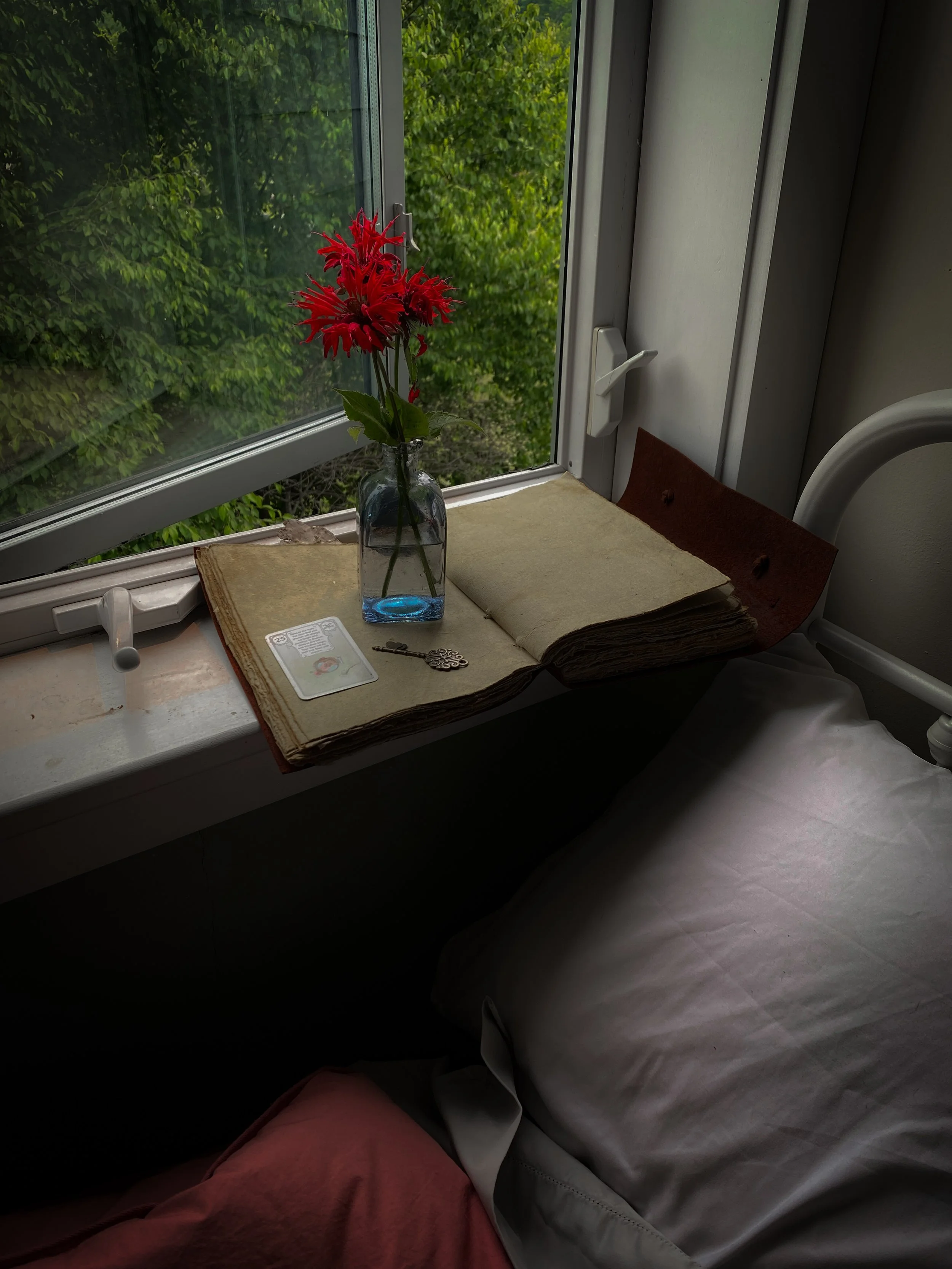
That evening, I cut a handful of bee balm and placed it in a vase beside my open window. I left my dream journal open beside the bed. A well-chosen Lenormand card and a small key rested on its pages as symbols of the doorway I hoped to open.
Then I whispered a simple invitation:
“May whatever beautiful and life-giving is seeking me find its way tonight.”
As I closed my eyes, I felt the breeze bringing bee balm closer to me, her aroma moving over my pillow, like a river of scent taking me into sleep.
That night I dreamed I met a new friend for tea. We talked about things that mattered. We ate sweet cakes, slowly and quietly and every bite made the color of my hair brighter. I mentioned this to her, surprised, but she just smiled. Before we parted, we put another date on the calendar. I woke with that unmistakable feeling dreams sometimes leave behind— a feeling of expanded potential and anticipation, like the song Something’s Coming from West Side Story.
The next morning, another hummingbird greeted me in the garden. It hovered just inches from my left ear, carrying the old Highland seers described so often, that unmistakable sense that something had arrived in greeting before its body did.
Later that afternoon, a message appeared on my phone.
A new friend inviting me to lunch.
Coincidence?
Maybe.
Or maybe this is what herbal dream magic looks like in practice. I don’t know if I would go as far as to claim plants can grant wishes, although I’m not ruling it out. I do believe plants can teach us how to participate more fully in the exchanges already happening between ourselves and the living world, between reason and intuition, between our conscious and unconscious, known reality and the infinite mystery.
This pollinator wisdom comes with a warning. There is a shadow side to summoning magic. If your self-esteem piggy bank is running on empty, it can become difficult to recognize what truly nourishes you. You might be tempted to settle for crumbs, or mistake flies for hummingbirds. You may find yourself opening the door to people, opportunities, or patterns that don’t actually nourish you. This isn’t because you’ve failed or “manifested” something bad. It’s because we often accept what matches our sense of worth.
Take heart, even the flies have medicine. Sometimes they arrive to remind us where the compost pile is, what needs cleaning up, or where our boundaries have worn thin. When our dreams turn dark, they, too, are teachers, meant to wake us up to the patterns and to choose a better outcome. So don’t worry if your summoning magic brings unexpected results, at first.
The more deeply you believe you are worthy of beauty, kindness, and reciprocity, the easier it becomes to welcome the pollinators and gently usher the flies back out the window.
If you’d like to try bee balm’s pollinator magic, here’s a simple summer ritual.
Summoning Tea
Inspired by the traditional Oswego tea shared by the Haudenosaunee, brew:
1 tbsp fresh (or 2 tsp dried) bee balm leaves and flowers
a few fresh mint leaves
a drizzle of local honey
Steep for 8–10 minutes.
Drink slowly near an open window at dusk.
As you sip, ask yourself:
What am I ready to welcome in?
Before bed, place a small bouquet of bee balm on your windowsill and leave the window open. No screen. Allow the elements and the winged ones to alight upon you while you sleep.
You don’t have to ask for anything specific, although you certainly can, if you know what you want and you are ready to welcome it in.
Because it’s new moon, I’m going to repeat this summoning spell this evening, asking for a lucid dream. Wanna join me? Let me know if you do!
Sources
Daniel E. Moerman. Native American Ethnobotany. Timber Press, 1998.
U.S. Forest Service. “Plant of the Week: Monarda didyma (Scarlet Bee Balm).” https://www.fs.usda.gov/wildflowers/plant-of-the-week/monarda_didyma.shtml
Alexander Carmichael, Carmina Gadelica, vol. II (Edinburgh: T. and A. Constable, 1900), “Love Charms.”
Christopher A. Faraone, Ancient Greek Love Magic (Cambridge, MA: Harvard University Press, 1999); see also The Greek Magical Papyri in Translation, ed. Hans Dieter Betz, 2nd ed. (Chicago: University of Chicago Press, 1992).