A Midsummer Dream Spell with St. John's Wort
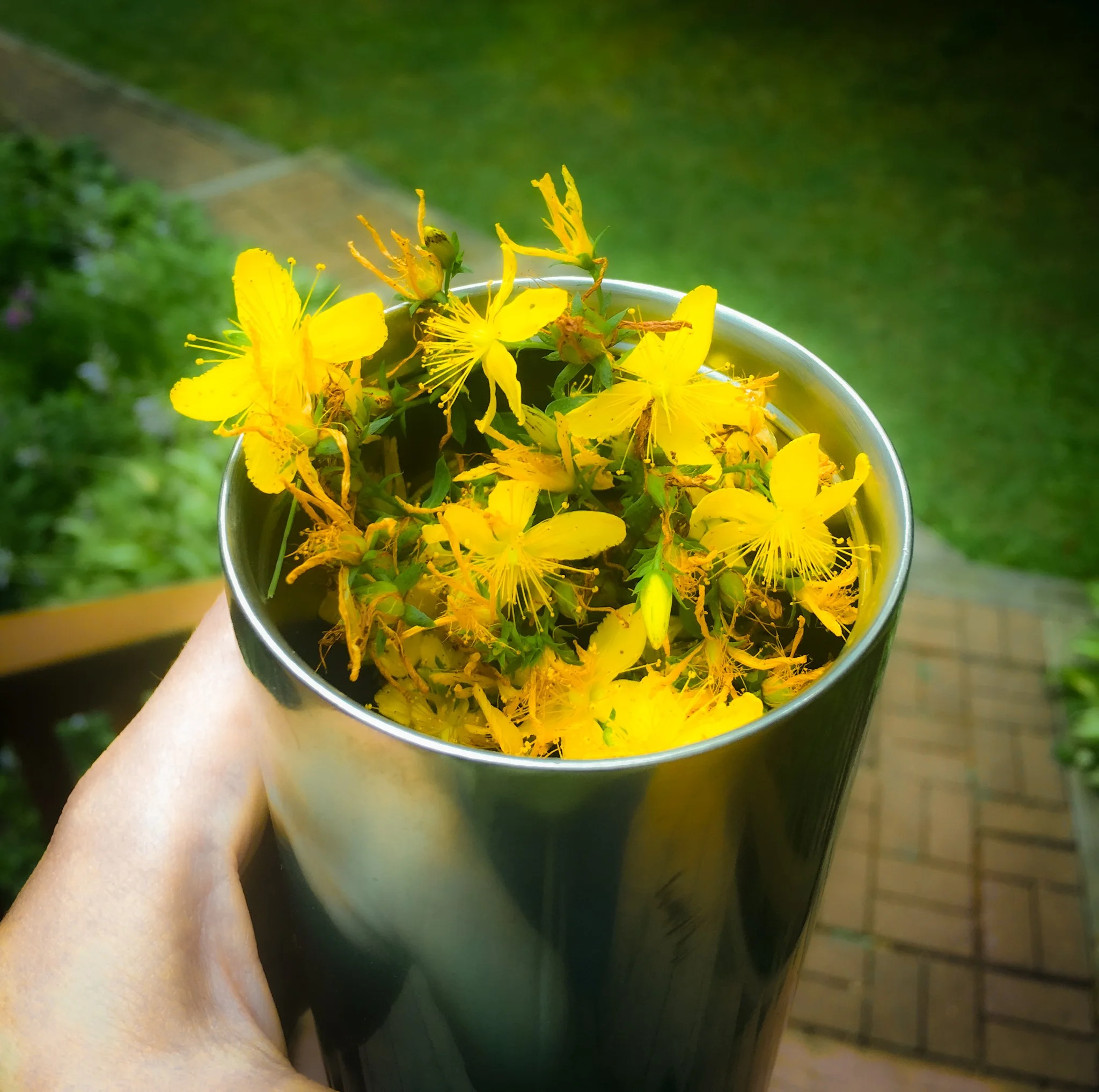
The summer solstice has come and gone, but for me, the true height of summer doesn't arrive until the little sunny stars of St. John's wort blossoms explode in their full summer glory.
This year, a few blossoms opened on the solstice itself, but the plant is only just coming into its fullness. Which means this is still a beautiful week to dream with the light.
The old herbalists gathered St. John's wort close to midsummer, when the days stretched longest and the sun seemed reluctant to leave the sky. Its golden flowers appear just as the wheel of the year reaches its brightest turning, carrying something of the summer sun into the darker half of the year.
Many herbalists know St. John's wort as a plant for lifting the spirits or soothing the skin. I love it for another reason.
I love it as a dream plant.
It was one of the first plants that taught me about lucid dreaming—not simply becoming aware that I was dreaming, but embodying what my mentor, Dr. Clare Johnson, calls the lucid light: a quality of awareness that brings clarity, compassion, and wisdom into the dream itself. Some of the most life-changing dreams I've ever had have come in relationship with this bright midsummer ally.
One of the places where I most need that light is in my own self-doubt.
Despite years of practice, I still have days when I wonder whether I've imagined this whole path. Whether I should stop writing books about dreams and plants and focus on a “real job.” Whether this work I've devoted my life to is simply too strange to belong in the world.
Whenever those doubts become too loud, the dreaming world has a remarkable way of answering.
Recently, after one of those days, I dreamed that I was gathering green plant fibers from the garden – weeds and vines that were growing all over – and twisting them into cordage. As I spun them together, the strands began to glow. Vine became thread. Thread became rope. Rope became radiant chords woven from living light.
The best feeling in the dream was the ease. It wasn't difficult at all! I wasn't struggling or striving. My hands simply knew what to do. I found myself showing others how do it, delighted by how naturally the light emerged from the plants. I felt a humble kind of pride and collective enjoyment in sharing this wonder — plant wonder.
I woke with the peaceful certainty that I was doing my work. That I was on the path. The dream seemed to be encouraging me to keep gathering what grows from the living world and spin it into stories, practices, and relationships that help others find their own thread of light.
I think of these as luminous dreams—dreams that carry a kind of magical and uplifting illumination, sparking insight, brightening the spirit, and rekindling wonder. They reveal the gifts of the more-than-human world and gently re-enchant my heart whenever it begins to forget.
The following midsummer dream spell is an invitation to carry a little of St. John's wort's golden light into your own dreaming. Whether you long for brighter dreams, clearer dream recall, or simply a deeper relationship with the wisdom that visits in sleep, may this simple ritual help illuminate the bridge between the dreaming and waking worlds.
A Beginner’s Midsummer Dream Spell with St. John’s Wort
This is a simple spell, and an effective one, too. Keep a light touch. Use what you have. You do not need to have St. John’s wort growing in your garden. You can use a small amount of dried St. John’s wort, a flower essence bottle, a picture of the plant, or even a golden candle or stone to represent its bright midsummer spirit.
You will need:
A dream journal or notebook
A pen
A small sprig of St. John’s wort, dried St. John’s wort, a flower essence, or an image of the plant
Optional: a yellow or gold candle, a cup of calming tea, or a small bowl of water
1. Prepare your bedside altar
Before bed, place your dream journal and pen beside you. Set your St. John’s wort, image, or symbolic golden object nearby.
Let this little arrangement be simple. A bedside altar does not need to be elaborate. It is only a way of saying to the dreaming world: I am listening.
2. Connect with the light
If you have fresh or dried St. John’s wort, hold it gently in your hands. If you are using an image, look at it for a few moments. If you are using a candle or golden object, let your eyes rest there.
Imagine the warmth of midsummer sunlight—not harsh or blinding, but golden, kind, warm, and steady.
Place one hand on your heart and one hand on your forehead.
Take three slow breaths.
3. Speak your intention
Whisper, or say silently:
St. John’s wort, flower of midsummer light,
carry your golden brightness into my dreams.
Help me remember what is ready to be remembered.
Illuminate the bridge between sleeping and waking.
May I receive even one clear image, feeling, word, or sign.
May I wake with a thread of dreamlight in my hands.
4. Ask one simple dream question
Choose one question before sleep. Keep it gentle and open-ended.
You might ask:
What light is trying to reach me now?
Or:
What do I need to remember?
Or:
What small guidance is ready to come through my dreams?
Write the question at the top of your journal page.
5. Go to sleep without trying too hard
This is important. Dream magic works best with playfulness and invitation, not force.
You don’t need to become lucid. You don’t need to have a big dream. You don’t need to remember everything.
As you fall asleep, imagine one golden thread stretching between your dreaming mind and your waking mind.
6. Gather the dream fragments when you wake
Before checking your phone or getting out of bed, stay still for a moment. Keep your eyes closed.
Ask yourself:
What was I dreaming?
Review whatever fragments remain. Don’t rush. Keep your mind open, like a palm, inviting the dream threads to gather there with your receptive mental presence.
Write down anything: a color, a feeling, a person, a sentence, a place, a body sensation, a symbol, even the faintest mood.
Treat your dream threads, however short or frayed, as sacred.
7. Thank the dream, and the plant
After writing, place a hand over your journal and say:
Thank you for what came through.
May the meaning unfold in its own time.
Make a small offering to the spirit of St. Johnswort. This can be a breath, a song, a glass of water, or some other token.
Hints for Herbal Dream Divination - How to Understand the Dream Messages
After getting up and starting your day, return to your journal with a warm cup of tea. If St. John's wort is appropriate for you and doesn't interact with any medications you're taking, you might enjoy a small cup of the tea or a few drops of tincture as you revisit your dream. Otherwise, simply invite the spirit of the midsummer plant to accompany your reflections. Let the warmth slow you down. Read your dream again, this time as though it were a letter written just for you. Sit with the dream like a beloved companion while you sip your tea.
Guiding questions for dream divination:
What are the main symbols or images? Notice the images that linger with you after waking. Rather than asking, "What does this symbol mean?" begin by asking, "What does it remind me of?" Let your mind wander. Your first associations are often the most revealing. Dreams speak in the language of memory, feeling, and metaphor. Free associate on each of them. What do they remind you of? What do they make you think of? Do you find any connection in your waking world to those images or symbols? Your personal associations are like keys to unlocking the messages. You don’t have to know exactly what they mean, but invite them to speak to you and play with them. Find connections. Weave the dream threads.
What is the emotional tone of the dream? And where in your waking world do you feel that same way? Most dreams carry a kind of emotional arc or charge. Look for the feelings and write them down. Were you curious? Ashamed? Delighted? Afraid? Peaceful? Ask yourself where that same feeling is alive in your waking life. Often the emotion is the bridge between the dream and the day. Also notice if the mood tone changes throughout the dream. Do you begin with hope but end in sorrow? Are you worried about something, but then it resolves into confidence? Your dream may be helping you process strong emotions from the past or prepare you for emotional experiences in the future. The thread to follow is the feeling itself, and to ask yourself where in your life you are feeling the very same thing. Herbal dream allies like St. Johnswort can provide a corrective and coutnerbalancing support for emotional regulation. SJW can provide the strength and safety to feel strong emotions or help you detach from emotional entanglements, recover connection with joy and ease, or release negativity. St. Johnswort often brings clarity and calm to turbulent emotional .
What was the main action or story of the dream? How is your dream reflecting back to you a story in your waking world or the wider world? Think of your dreams like maps, guiding you from one way of being, into a new and better way. If you follow the plot, and write it down in generic terms without the specifics, you might reveal the solution or the treasure map. For example, if you dream about driving up a steep hill in a truck with another person, but the car stalls and you have to get out and walk, you might understand this dream to be showing you how to deal with a difficult situation with the person, and in order to move through the challenge, you have to find a new way, a method that may seem harder at first, requiriing you to stand on your “own two feet” and find your own strength, to simplify and even “go it alone” for a while.
What is the takeaway? If this dream had one message for you, what would it be? Understand that all dreams have multiple layers of truth. Dreams are complex and rarely mean one single thing. You can learn to hold that complexity and also distill out something useful for your life in the moment. All dreams carry helpful codes for improving your current reality. How is the dream inviting you to upgrade your life right now? You can always come back to the dream in the months and years ahead and glean new insights and treasures. But the message you take away today is the one that matters in the present.
What would the plant say? If you get stumped, try free writing or “automatic writing” in the voice of St. Johnswort - a dream herb that knows just what your dreams are trying to tell you. Imagine the plant sitting across from you in the morning sunlight. Ask: What are you trying to show me through this dream? Then write without censoring yourself. Don't worry whether the words are "really" coming from the plant or from your own imagination. Relationship often begins in precisely this place—where imagination and listening become impossible to separate.
What is one action I can take in my waking life to honor the spirit/message of this dream? Last but not least, write down and commit to one action you can take on behalf of the dream. It’s important to honor the wisdom of the dream in the waking word. This could be something small, like I will tell my dream to a friend or therapist, or drawing a picture of the symbol in your journal, or taking the suggestion of a dream and embodying it in real life. For example, if you dream of swimming in a clear stream, go find a stream and have a splash! Depending on the message dream plot, the symbolismYou can also consider a bigger call to action, such as learning a new skill, confronting a fear, tackling a task you’ve been putting off, or making a decision.
If you enjoyed this, you’ll love my book Herbal Dream Magic, which is full of more plant spirit wisdom and dreamwork practices to enchant your world.
You can order your copy at one of these links:
Herbal Dream Magic | Llewellyn Worldwide, Ltd.
Herbal Dream Magic: Spells and Rituals with Plant Allies | Barnes & Noble®
Herbal Dream Magic a book by Audrey Gilbert - Bookshop.org US